The Prayer Of The 13th Warrior

Published / by Jehangir

Two movies I watched on HBO recently featured muslim characters.

In the 'The 13th Warrior' Antonio Banderas plays the role of an exiled Arab nobleman who abets Vikings in their hair-raising encounters against a tribe of underground-dwelling neo-neanderthals. His role is in itself a rarity – a positive Muslim character in a major Hollywood film.

Morgan Freeman playing Kevin Costner's companion in 'Robin Hood: Prince of Thieves' is another such role that comes to mind. Usually the stereotyped Muslim characters you see in every other mainstream Hollywood movie play the roles of 'islamic' terrorists.

Since it's a Hollywood movie, 'The 13th Warrior' suffers from fundamental errors like the climatic prayer scene before the final battle, where neither the Muslim nor the Norse characters recite traditional prayers but instead prayers from unverified sources are included by the scriptwriters for their ‘historical fantasy’ effect. The Antonio Banderas/Ibn Fadlan character recites a hollywood-ified version of the following prayer:

For all that we should have thought
and have not thought;
For all that we should have said
and have not said;
For all that we should have done,
and have not done;
We pray to the Lord for forgiveness.

For all that we should not have thought
but have thought;
For all that we should not have said
but have said;
For all that we should not have done,
but have done;
We pray to the Lord for forgiveness.

In the film version, Antonio Banderas as Ibn Fadlan prays not to 'Allah' but to 'Holy Father' in true Christian fashion.

Thankfully, the director does not show a Muslim character being cremated – as happens onscreen in 'The Ghost & the Darkness'. That blooper apart, TG&TD is one of my favourite films. It's like ‘Jaws’ with claws !

Unlike the majority of film adaptations, both films surprisingly complement the books they are based on – Michael Crichton's 'Eaters of the Dead' and 'Man-eaters of Tsavo' by John Patterson. Since both these films are based on actual persons/events, Muslim characters were essential to the plots.

How hard can it be for Hollywood to do a wee bit of research and portray characters belonging to any particular religion accurately?

White Swans of Kashmir

Published / by Jehangir

Most westerners that figure in the history of Kashmir were either missionaries like C. E. Tyndale-Biscoe or employees of the Maharaja's like W R Lawrence. However a few like Freda Bedi were involved with Kashmir not as a career option, but because they chose to be.

Freda Bedi was an Englishwoman who met and married B. P. L. (Baba) Bedi at at Oxford University. During the struggle against the Maharaja, the Bedi's were closely associated with the National Conference, especially with Sheikh Mohammed Abdullah.

Their communist leanings are believed by some to be the influence for the admittedly leftist slant of the 1944 'Naya Kashmir' manifesto. Freda Bedi delivering messages to jailed National Conference leaders wearing a 'Burkha' is part of freedom struggle folklore.

My grandmother would sometimes talk about her – especially when Kabir Bedi was on TV. I don't remember the context now but I believe it had something to do with Begum Abdullah, with whom my grandmother had been closely associated. Kabir Bedi, the film actor, is Freda Bedi's younger son. The Bedi family used to own property in my neighbourhood (Shivpora) and I seem to remember that the elder son, Ranga Bedi was a friend of my eldest brother.

Edna Bellafontaine was more of a mystery. Unlike the other two, there is very little information on this Englishwoman, the self-confessed 'Mata Hari of Kashmir'.

Till I came across the news item I thought she was a mid-century painter. I have a painting signed ' Edna Bellafontaine 1949' hanging in my living room, and have seen her works in the homes of certain old families in Kashmir.

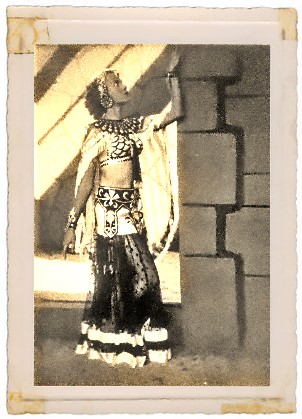
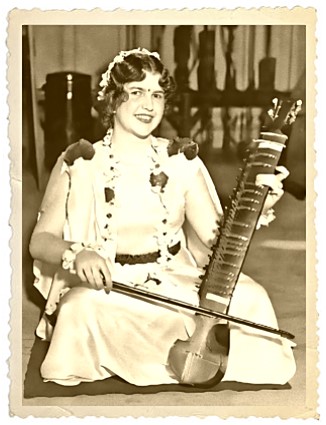
Nilla Cram Cook is the most intriguing of the three. According to a 1933 Time Magazine article titled the 'Runaway Disciple',

'Of all his strange disciples the one who has caused Mahatma Gandhi the sharpest pangs of dismay is plump & pleasing Nilla Cram Cook, 23-year-old daughter of the late George Cram Cook, Iowa poet. …..

……Her difficulty in adjusting her good intentions to her Iowa temperament caused sorrowing St. Gandhi to embark on a hunger strike seven months ago'

Besides being Mahatama Gandhi's most troublesome disciple, she apparently wrote and translated poetry, flirted with mysticism, reinvented dance in Iran, and worked as cultural ambassador for the United States.

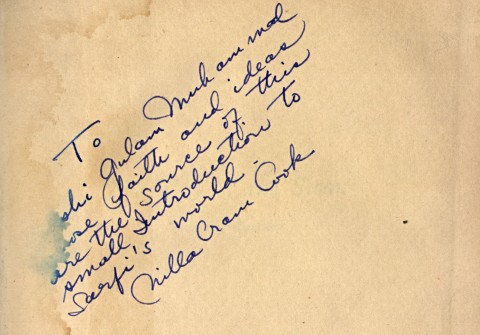
Nilla Cram Cook's Kashmir connection is 'The Way of the Swan', her gem of a translation of the the works of Kashmiri mystics including the Lol's or love poems of Habba Khatoon / Zooni. This is the inscription on a copy of the book she presented to my father:

The Age Of Innocence

Published / by Jehangir

I grew up on the banks of the Jehlum but spent most evenings in and around the Dal Lake with my cousins. My maternal grandmother's family occupied an estate on the Boulevard Road that encompassed a colonial bungalow with walnut, apple and quince-apple orchards. The orchards were interspersed with reed-beds and marshes that had once been connected with the lake.

My childhood memories of the Dal Lake echo crystal clear waters, weeds that were visible only underwater and house-boats so far away from the Boulevard Road that one had to strain to make out a familiar face. I remember my cousin Irfan – aka Hero, sadly no longer with us – warning younger kids that these unseen underwater weeds would entangle and drown the careless. The ubiquitous red-green algae that today seems to cover the entire lake was confined to the marshes and confounded our efforts to retrieve the wooden "birra" or unwieldy "cork" balls that we used to play cricket with.

Angling and boat-rides on "borrowed" Dakotas – our term for larger, uncovered shikaras – were favourite pastimes. The irate owner of the commandeered dakota would be immediately pacified by a mention of my grandmothers name. Begum Jalaluddin, or Barkat Begum as she was affectionately known, was a legend in her lifetime.

If the wind was favourable, kites flown from the pier below Almond Villa would consume multiple spools of expensive thread and soar way beyond Kotar Khana towards the Hazratbal shrine.

It was truly the age of innocence.

The orchards and marshes are long gone, sacrificed at the altar of crass commercialism. The estate was was acquired by the government to build an ugly concrete monolith which towers above my grandmother's house. The expansive orchard-lined driveway has disappeared and access is now through a filthy side-street narrowed by encroachments and choked with parked cars.

Shikara's still ply the waves though the mirror of the Dal Lake is scarred and rust-tarnished. The number of anglers has increased but they cast their lines between floating piles of filth. The corruption of the Dal Lake into a cesspool seems to mirror the degradation of the Kashmir Valley and of us, its people.