
This week, more than seven centuries ago, a vast Mongol/Tartar horde of 300,000 warriors led by Hulagu Khan captured and burned Baghdad to the ground in a week-long bloodbath. The Mongols razed three-quarters of Muslim territory, overthrowing the Abbasid empire and capturing Damascus, the other important centre of Islam. It was the most devastating chain of events in Islam’s history. After the destruction of Baghdad and Damascus, only Cairo, the seat of Islam’s true military power under the Mamluks, remained unconquered.
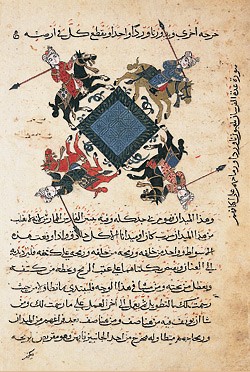
Image © Chester Beatty Library
Saif-ud-din Qutuz , the Mamluk ruler of Egypt, recieved a chilling message from Hulagu:
From the King of Kings of the East and West, the Great Khan.
To Qutuz the Mamluk, who fled to escape our swords.
You should think of what happened to other countries and submit to us. You have heard how we have conquered a vast empire and have purified the earth of the disorders that tainted it. We have conquered vast areas, massacring all the people. You cannot escape from the terror of our armies.
Where can you flee? What road will you use to escape us? Our horses are swift, our arrows sharp, our swords like thunderbolts, our hearts as hard as the mountains, our soldiers as numerous as the sand. Fortresses will not detain us, nor arms stop us. Your prayers to God will not avail against us. We are not moved by tears nor touched by lamentations. Only those who beg our protection will be safe.
Hasten your reply before the fire of war is kindled. Resist and you will suffer the most terrible catastrophes. We will shatter your mosques and reveal the weakness of your God, and then we will kill your children and your old men together.
At present you are the only enemy against whom we have to march.
To consolidate power after establishing the Ayubid dynasty in 1174 AD, Salah-ud-Din Ayubi (Saladin) formed the Mamluks, an elite military force of slaves. In 1254 AD the Mamluks revolted, transforming themselves from slaves to rulers.
The Mamluks, too, had a formidable reputation as warriors, and Sultan Qutuz chose to resist despite being heavily outnumbered. Cairo was headed towards seemingly inevitable destruction when divine intervention in the shape of the Great Khan Mongke‘s death prompted Hulagu to return home to choose his successor in accordance with Mongol tradition.
A supremely confident Hulagu dispatched a force of 20,000 troops under the command of Kitbuqa to attack Egypt. Qutuz took decisive action and ordered his army to march out to engage the Mongols. Despite being staunch foes of Islam, the Crusaders recognised the Mongols as a greater common threat and provided safe passage and supplies to the Muslim army.
On September 3rd, 1260 AD, the two armies met in Ain Jalut (Goliath’s Springs) in modern-day Palestine. The Muslim army was on the verge of being overrun when Qutuz rode into the midst of the battle and began a ferocious attack on the Mongols. Shouting ‘O Muslims! / Wa Islamah!’ he threw down his helmet so that his warriors would recognise him. His actions inspired his warriors to defeat the Mongols in direct combat on the battlefield, something that no army had previously done.
The clash between Mamluk and Mongol armies at Ain Jalut seven centuries ago was one of the most significant battles of world history. The empire of Islam was within a few sword strokes of being wiped out and Europe, which had already been invaded through Poland, would be next in line to face the wrath of the Mongols. By smashing the myth of Mongol invincibility the Mamluks ensured the survival of both Islamic and Western civilizations as we know them today.
An interesting sideline is that within 35 years of the battle, Islam had managed to assimilate the Mongols. Hulagu Khan became embroiled in internecine battles with his cousin Berke Khan who had converted to Islam, and never threatened these lands again. Ghazan Khan, ruler of one of the four descendant empires of the Mongol Empire (Ilkhanate), converted to Islam after his enthronement in 1295. The Great Mughals , who claimed descent from Genghis Khan, ruled most of the Indian subcontinent from the early 16th to the mid-19th centuries.

Tail-piece:
Matt Zervas points out that the Mughals were descendents of Timur the Lame, who was a Muslim and claimed descendency from Genghis Khan yet was labeled an enemy of Islam by the Caliphate after sacking and basically exterminating Baghdad (again), Aleppo and Damascus. Another twist.

