The Trout Angle

Published / by Jehangir

Kashmir has earned a well-deserved reputation as an angler's paradise. With the demise of the great Mahseer, the Trout is the undisputed numero uno game fish of Kashmir.

In 1899 Frank Mitchell, Colonel's Ward and Unwin, and Captain Allan contributed the sum of 50 pounds each to import trout from Scotland to Kashmir. The Duke of Bedford provided a consignment of 10,000 trout ova, but the first batch perished at sea. The second batch of eyed-ova travelled by steamer to Bombay, then by rail upto Rawalpindi – and survived an ardous bus journey to reach Srinagar in December 1900. The hatchlings were reared in a pond in Frank Mitchell’s carpet factory at Bagh-i-Dilawar Khan before being transferred to a hatchery established under his supervision at Harwan at the outlet of the Dagwan stream from Dachigam.

Trout thrive in rushing cold streams and the Dagwan running through the Maharaja's shooting preserve proved to be the perfect trout stream. Later aged ova and yearling trout were introduced in other streams in Kashmir like Achabal, Wangat, Veshav, Kishenganga, Liddar, Marwar and Erin among others. Yearlings were also released in the Burzil and Gurez streams, the Gangarbal Lake, and in the Poonch River. In the 1950's, rainbow trout from Denmark were introduced in Kashmir.

The brown (Salmo trutta) and rainbow (Oncorhynchus mykiss) varieties adapted to Kashmir's rivers and thrived to the extent that they were later introduced in other states like Himachal Pradesh, Uttar Pradesh, Arunachal Pradesh, Sikkim and Bhutan.

Anyway, Hermes and not Mammon is my muse when I avow that the sport of trout fishing is addictive to the point of becoming an obsession. There can be no better introduction to the thrill of angling for trout in Kashmir than the first few paragraphs of this article from the New York Times circa 1983. Compare it to the reprint of A Day on a Kashmir Trout Stream from a century earlier.

The Masjid and Yennar beats on the Lidder in Pahalgam remain my favourite beats as I have rarely angled any other stream except for a few unsuccessful casts in the Ferozepur Nallah. A whole day on Tilwan Kol, the little creek that runs through the exquisite untamed Bangus valley proved entirely fruitless while the plop-and-land excess of the Gangabal Lake provided a full bag but little sport. In my experience the trout from high-altitude lakes like Gangabal have bigger heads but smaller bodies, while the farm-reared variety are spongier than the fish caught in streams.

Trout from Kashmir's glacial streams, though smaller than elsewhere, are considered to be among the most delicious in the world. The State Department of Fisheries have a highly-popular sale for farmed trout on Saturdays, but we rarely avail the opportunity. The tastiest trout is the one that satisfies the appetite triggered by the thrill of having landed it with my own Shakespeare. One of the most memorable meals one can have in Kashmir is a trout hooked, gutted and cooked on-the-go. This page has a trout recipe fit for a king (quite literally, since the author is the present Maharaja of of Indore)

Nothing finer, anywhere, indeed.

Update: (2019) After 120 years, 2.25 lakh eyed ova have been imported from Denmark to the hatchery set up for the rearing of genetically improved Rainbow Trout at Beerwah Budgam.

Note: The official record holder for Kashmir is a 17+ pounder caught in the Verinag stream.
A Bridge named Albion?

Published / by Jehangir

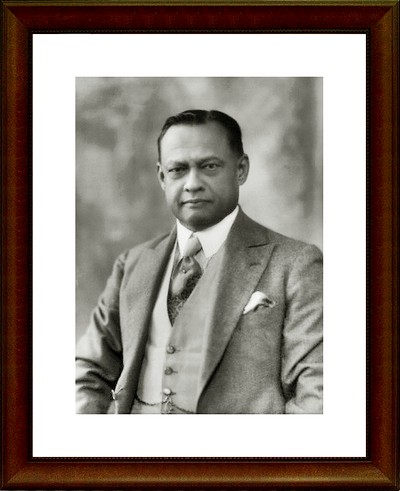
On this day in 1929 newspapers carried an article exposing the sectarian and autocratic character of the Dogra rule. The publication of this article emboldened Kashmiri muslims to raise the banner of protest. Remarkably, the article was written by the serving Prime Minister of Kashmir – Sir Albion Banerji.

Sir Albion R. Banerji, Kt., C.S.I. C.I.E., (1871 – 1950) was the first Bengali Brahman to be born in England, hence his unusual first name. He earned his Master's Degree at the Balliol College, Oxford and joined the Indian Civil Service in 1894. At the Delhi Durbar of 1911, Albion Banerji was awarded the Companion of the Indian Empire (CIE).

He served as Magistrate in the Madras Presidency, and as Diwan of Cochin and then of Mysore before joining the Maharaja's administration in Kashmir as the Foreign and Political Minister.

In 1927 Sir Albion Banerji was appointed Prime Minister of Kashmir.

On March 16, 1929, he published a scathing indictment of the administration of the Kashmir State – criticising the Maharaja's lavish lifestyle sustained by a poor population – and then resigned from his post.

Some excerpts from the note:

'Jammu and Kashmir state is labouring under many disadvantages, with a large Mohammedan population absolutely illiterate, labouring under poverty and very low economic conditions of living in the villages, and practically governed like dumb driven cattle.

There is no touch between the government and the people, no suitable opportunity for representing grievances…

The administration has at present no or little sympathy with people's wants and grievances…'

Sir Albion Banerji's resignation effectively ended his hitherto stellar career in the Indian Civil Service. This act should have made him a hero for the common Kashmiri.

Strangely, or maybe I should say expectedly, there is no mention of Sir Albion Banerji in the sponsored hagiographies that masquerade as history in today's Kashmir. His selfless act has been forgotten because no self-serving separatist, mainstream or 'slipstream' politician can legitimately claim his legacy.

Even the numerous 'civil society' groups peculiar to Kashmir, ever keen to jump on to any 'kashmir/kashmiriyat' bandwagon, have not instituted an award (their favoured ploy to stay news-worthy) in his name – the ultimate ignominy for a man who has had such an undeniable impact on the history of Kashmir.

Perhaps there is an undercurrent to Sir Albion Banerji's service in Kashmir that I have failed to observe, but the fact remains that he championed both the cause of the downtrodden muslim population of Kashmir and of the backward classes of India. Much to the discomfort of his peers, he protested the failure of the Dogra and the British rulers respectively to address their problems.

The erstwhile state of Cochin, which also had cause to honour the gentleman, has a street named after him. I had suggested in an earlier post that the new bridge over the river Jehlum at Rajbagh could be named the Albion Bridge to honour Sir Albion Banerji.

Any takers?

The ‘Flower King’ of Kashmir

Published / by Jehangir

As the snows melt, their whiteness is rivalled by the delicate sprays of early fruit blossoms as seen across the dark background of the cypress trees ; while the pink mist of almond and apricot flowers shows in little patches of colour against the bare hillsides.

Soon the ground under the trees is carpeted with bulbs, scillas, tulips, crown-imperials, narcissus, hyacinth, fritillaries, and iris. Take up a box of old Kashmiri lacquer-work and see how the flowers and colours crowd together.

Lilac, jasmine,and carnations follow ; then, last and best of all, come the roses, giant bushes covered with huge, pink, fragrant flowers, such masses as are seen in Europe only in the pictures of some fairy tale. White roses too, and red and yellow; but the pink roses were always the artist's favourites'.

~ Gardens Of The Great Mughals

Inspired by the impeccable English garden of the hotel run by the O'Connell's in the Batwara suburb of Srinagar in pre-independence days, Ghulam Nabi Wani set up what was probably the first commercial nursery in Kashmir.

In his heyday Ghulam Nabi Florist, as he is popularly called, supplied flowers to Prime Ministers of Kashmir and India and his cutflowers graced the poshest hotels in the country.

Sadly his business could not escape the evil eye that has consumed Kashmir and his efforts are now largely restricted to his nursery in Shivpora. When thousands of his blooms burst forth in the spring, there is no lovelier place in Kashmir.

Kashmir Country Garden

How many kinds of sweet flowers grow

In a Kashmir country garden

I'll tell you now, of some those we know

Those that I miss you'll surely pardon

Daffodils, pansies and phlox

Marigolds and White Snowdrops

Lilacs, Lilies and tall Hollyhocks

Roses, Asters and Tulips

Blue Forget-Me-Not's

In a Kashmir Country Garden…

~ Anonymous

Most of the perennials in my garden have been sourced from his nursery, and though I do not really have the space for more plants, I still visit his nursery each planting season.

This week I scored a bounty of tulips, scented narcissi and irises for my spring garden. This link has some pictures from my garden – past and present.