Category Archives: History

Revolutions and Roosting Hawks

Published / by Jehangir

Watching the revolt in Egypt on TV while helping my son with his poetry assignment, I had a flashback. From the depths of memory a Persian ode translated by Khushwant Singh popped into my head. I had read it in the Illustrated Weekly in 1979 alongside a caricature of Shah Mohammad Reza Pahlavi following the Iranian Revolution.

Think not, 0 King! thy sceptre or thy pow'r
one moment can arrest the destin'd hour !

Only time will tell whether the tumultuous events of the past week in the Middle East are genuinely popular movements, or are strings being pulled to replace politically-inconvenient stooge-dictators with politically-correct stooge-democracies?

Meanwhile enjoy the powerful imagery of Ted Hughes' ode to megalomaniac despots – the Hosni Mubaraks and the Ben Alis and their ilk.

Hawk Roosting*

I sit in the top of the wood, my eyes closed.
Inaction, no falsifying dream
Between my hooked head and hooked feet:
Or in sleep rehearse perfect kills and eat.
The convenience of the high trees!
The air’s buoyancy and the sun’s ray
Are of advantage to me;
And the earth’s face upward for my inspection.
My feet are locked upon the rough bark.
It took the whole of Creation
To produce my foot, my each feather:
Now I hold Creation in my foot
Or fly up, and revolve it all slowly –
I kill where I please because it is all mine.
There is no sophistry in my body:
My manners are tearing off heads –
The allotment of death.
For the one path of my flight is direct
Through the bones of the living.
No arguments assert my right:
The sun is behind me.
Nothing has changed since I began.
My eye has permitted no change.
I am going to keep things like this.

Just brilliant !

*© rests with owner. Provided gratis for educational purposes.

White Swans of Kashmir

Published / by Jehangir

Most westerners that figure in the history of Kashmir were either missionaries like C. E. Tyndale-Biscoe or employees of the Maharaja's like W R Lawrence. However a few like Freda Bedi were involved with Kashmir not as a career option, but because they chose to be.

Freda Bedi was an Englishwoman who met and married B. P. L. (Baba) Bedi at at Oxford University. During the struggle against the Maharaja, the Bedi's were closely associated with the National Conference, especially with Sheikh Mohammed Abdullah.

Their communist leanings are believed by some to be the influence for the admittedly leftist slant of the 1944 'Naya Kashmir' manifesto. Freda Bedi delivering messages to jailed National Conference leaders wearing a 'Burkha' is part of freedom struggle folklore.

My grandmother would sometimes talk about her – especially when Kabir Bedi was on TV. I don't remember the context now but I believe it had something to do with Begum Abdullah, with whom my grandmother had been closely associated. Kabir Bedi, the film actor, is Freda Bedi's younger son. The Bedi family used to own property in my neighbourhood (Shivpora) and I seem to remember that the elder son, Ranga Bedi was a friend of my eldest brother.

Edna Bellafontaine was more of a mystery. Unlike the other two, there is very little information on this Englishwoman, the self-confessed 'Mata Hari of Kashmir'.

Till I came across the news item I thought she was a mid-century painter. I have a painting signed ' Edna Bellafontaine 1949' hanging in my living room, and have seen her works in the homes of certain old families in Kashmir.

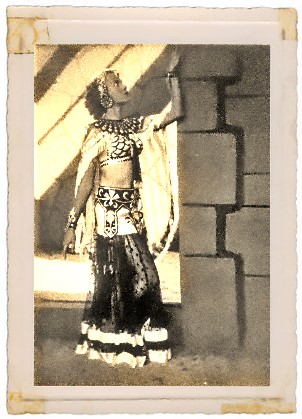
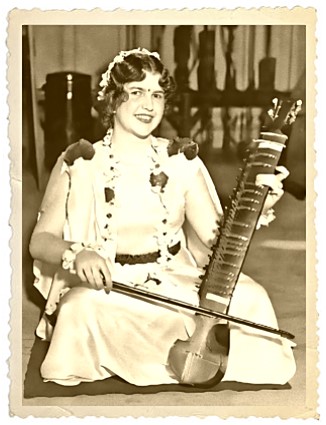
Nilla Cram Cook is the most intriguing of the three. According to a 1933 Time Magazine article titled the 'Runaway Disciple',

'Of all his strange disciples the one who has caused Mahatma Gandhi the sharpest pangs of dismay is plump & pleasing Nilla Cram Cook, 23-year-old daughter of the late George Cram Cook, Iowa poet. …..

……Her difficulty in adjusting her good intentions to her Iowa temperament caused sorrowing St. Gandhi to embark on a hunger strike seven months ago'

Besides being Mahatama Gandhi's most troublesome disciple, she apparently wrote and translated poetry, flirted with mysticism, reinvented dance in Iran, and worked as cultural ambassador for the United States.

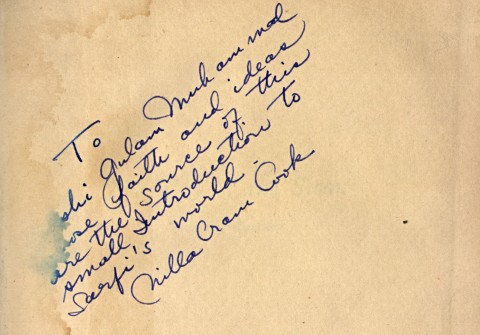
Nilla Cram Cook's Kashmir connection is 'The Way of the Swan', her gem of a translation of the the works of Kashmiri mystics including the Lol's or love poems of Habba Khatoon / Zooni. This is the inscription on a copy of the book she presented to my father:

Archaeology and Astronomy at Burzahom

Published / by Jehangir

Burzahom was the first Neolithic site to be discovered in Kashmir.

It is located on a ‘karewa‘ between the banks of the Dal Lake and the Zabarvan hills, about 5 km from the famous Mughal garden of Shalimar. Burzahom translates as ‘place [ hom ] of birch [ burza ]‘ in Kashmiri.

Plentiful food from the forests on the Himalayan foothills, abundant water supply from the lake and a raised location protected from seasonal flooding ensured that the Burzahom plateau remained continuously settled from the Stone Age [2400 B.C] to the Early Historical period. The inhabitants progressed from hunt-and-gathering pit-dwellers to a pottery-making agricultural society over the ages.

A rock carving unearthed at the site shows two hunters hunting a stag while twin suns shine in the sky. The engraving on the slab depicts hunting scenes showing an antlered deer being pierced from behind with a long spear by a hunter and an arrow being discharged by another hunter from the front. The slab seems to reveal that hunting was still a part of the life of the Neolithic people of Burzahom.

The presence of two similar suns in the sky is however a mystery.

Some researchers believe that the twin suns indicate the duration of the hunt, while a far more exotic (and convincing, IMHO) theory has been proposed by a team of astronomers who believe that the scene represents the ancient night sky with the two suns actually representing the moon and a supernova*, while the hunters and the animals represent constellations like Orion and Taurus.

If the latter theory is to be believed, it would represent not only the first record of a supernova, but also the oldest sky-chart ever discovered!

* A supernova is the explosion of a massive star which produces an extremely bright object that gradually fades away over weeks or months.

Burzahom lies just off the Shalimar-Telbal road and is well worth the short trip to experience the history it represents.

Learn more about Burzahom here.

Update (2019):
I feel that in ancient times the Dal lake would have extended to the boundaries of Burzahom which seems to have the perfect attributes for a shore settlement. Unfortunately unplanned construction is taking place in the most likely place where an anchorage would have existed. Indeed the construction monster may soon devour Burzahom. Shame!