Category Archives: History

The History of Healthcare in Kashmir

Published / by Jehangir

The history of modern health care in the pre-independence era in Kashmir is synonymous with the efforts of Christian missionaries. While their motives were admittedly of a missionary nature and their attitude mostly contemptous towards local faiths and customs, yet the pioneering role of the members of the Kashmir Medical Mission cannot be denied.

The first modern hospital in Kashmir was the Mission Hospital at Drugjan. In 2017, I had the privilege to serve as the Medical Superintendent of this hospital, nowadays known as the Government Chest Diseases Hospital. During my research to establish the history of healthcare in Kashmir I came across some rare images which I am sharing here.


Dr William Jackson Elmslie (1832–72)

Dr. William J. Elmslie, the first medical missionary appointed by the Kashmir Medical Mission in 1865 was unable to obtain accommodation due to strong official and public opposition to the missionary component of his medical activities. With typically Scottish derring-do he managed to examine and treat thousands of patients in a single tent which served both as OPD and IPD!

Dr. Elmslie’s successor, Dr. Theodore Maxwell, was politically well-connected and was able to ensure that official opposition was withdrawn. Maharaja Pratap Singh granted the Kashmir Medical Mission land for a hospital at Drugjan on the Rustam Garhi hill.


This image titled ‘Dispensary Tent of the Cashmere Medical Mission’ depicts Dr. Robert Maxwell in Kashmir in 1874. Note the sign at the left of the image.

By means of personal contributions and donations from friends in England, Dr. Edmund Downes erected the first buildings of the Mission Hospital at Drugjan.


Patients recuperating in the upper verandah of the ward named after Dr. Downes.

The Neve Family, notably Dr. Arthur Neve, Dr. Ernest Neve and their sister Ms Nora Neve (Superintendent of Nurses) performed stellar services at the Mission Hospital and in the field. Dr. Arthur Neve was awarded the Kaiser-i-Hind Gold Medal in 1901.


The caption states that ‘These extensive buildings, on a terrace 250 yards long, were erected by the Brothers Neve between 1888 and 1896, at a cost of approximately £15,000, without any Government or other grant’.


Dr Arthur Neve and hospital staff with patients at the Mission Hospital in 1882.


A field health camp being conducted by Dr. Arthur Neve. Note the dispensary table at the right of the image.


It was not uncommon for patients to be transported by boats.

The never-say-die missionary zeal burned as brightly in female medical missionaries as in their male counterparts.

In May 1888, Dr. Fanny Butler, the first female medical missionary in India, started a dispensary in Srinagar city called the “Zenana Shifa Khana” under the aegis of the Church of England Zenana Missionary Society (CEZMS).

Nursing activities were championed by the likes of the indefatigable Irene Petrie who gave up a life of luxury in England to endure hardships in Kashmir, and Elizabeth Mary Newman who was bestowed the title of the ‘Florence Nightingale of Kashmir’ by Tyndale-Biscoe for her work at the CEZMS Hospital. She recieved a Kaisar-e-Hind Silver Medal for her services to the hospital.

The first Church of England Zenana Missionary Society (CEZMS) Hospital was established at Rainawari in 1908. This building was demolished a few years ago to build a shopping complex. (So much for heritage preservation.)


The foundation stone of CE Zenana Missionary Society Hospital at Rainawari was laid by C.E. Tyndale Biscoe on 17th October 1908.

In 1891 the Maharajah of Kashmir donated land and money for setting up a Visitors Cottage Hospital at the foot hills of the Shankaracharya Hill so white people would not have to suffer in the company of natives.

The Visitors Cottage Hospital is nowadays called the Kashmir Nursing Home and I am currently on my second stint as its Medical Superintendent.


Franciscan Missionaries of Mary treating patients at Baramulla in 1921.


Dr. Noel Fletcher examining patients at John Bishop Memorial Hospital at Anantnag in the 1950s.

One positive spin-off of the activities of the medical missionaries was that they prompted the Maharaja of Kashmir to set up the State healthcare services.

The foundation stone of the State Hospital (SMHS) was laid by the Marquess of Linlithgow, the Viceroy of India in 1940 at the estate of the Hadow Mills Carpet Factory. This is the reason why the hospital is known colloquially as Hadwun (Hadow’s) Hospital even today.

The first medical college in Jammu & Kashmir started functioning at Hazuri Bagh on the banks of the Jhelum at the site of the present Lal Ded Hospital in 1959. The Government Medical College Srinagar was inaugurated at its present day location in Karan Nagar by Bakshi Ghulam Mohammed, Prime Minister of the State of Jammu and Kashmir, in 1961.


The first batch of GMC Srinagar.


Students at GMC Srinagar in the 1970’s.

Click this link for a primer on the History of Healthcare in Kashmir [PDF]

Kashmir vs Cashmere

Published / by Jehangir

Kashmir is one of the most beautiful places on earth.

Cashmere* is one of the most expensive fabrics in the world.

Kashmire, Cashmeer, Cashmere, Cashmire, Kashmeer and Kashmir have all been used throughout the past few centuries to describe the Vale of Kashmir.

Writing about the travels of Francois Bernier, George Forster used the spelling ‘Kashmire’ for the valley in 1783. He also used ‘Kashmire’ in the title of his 1798 book ‘A Journey from Bengal to England – through the Northern part of India, Kashmire, Afghanistan, and Persia, and into Russia by the Caspian Sea.’

With the advent of the nineteenth century, the term ‘Cashmeer’ to denote the valley seems to have gained popularity while ‘Kashmire’ just disappeared. ‘Cashmeer’ was used in books like ‘The Commerce and Navigation of the Ancients in the Indian Ocean‘ published in 1807 and ‘The Arabian Nights‘ published in 1811.

In subsequent decades ‘Cashmeer’ was used interchangeably with ‘Cashmere’ till it fell out of favour and the latter became increasingly frequent by the 1840s. A few instances of ‘Cashmeer’ can be found in the 1850s and the 1860s, before bowing out in 1871 in an inexplicable blaze of glory having being brought centre-stage by Robert Shaw, an old Kashmir hand writing about his exploits in ‘Visits to High Tartary, Yarkand and Kashgar.’

I say inexplicable because the gentleman responsible for the last mainstream use of the term ‘Cashmeer’ served as the British Commissioner in Leh and must have been well aware that the official name of the kingdom by the 1870s was ‘Kashmir’ – even ‘Cashmere’ having been officially relegated by that time.

Strangely enough around the same time a pamphlet written in defence of the Maharaja of Kashmir in 1870 was titled ‘The Maharaja of Kashmeer and his Calumniators‘, marking a rare use of the term ‘Kashmeer.’ The pamphlet sought to counter western authors severely castigating the Dogra ruler for his misrule – ‘The Wrongs Of Cashmere‘ (1868) by Arthur Brinckman and ‘Cashmere Misgovernment‘ by Robert Thorpe published posthumously in 1870.

‘Cashmire’ was intermittently used over the years, primarily in literary works, and while writing in or translating from French, with ‘Kaschmir’ being the German equivalent.

One of the earliest uses of the modern name ‘Kashmir’ is found in the ‘Historical and Descriptive account of British India‘ published in 1832 by a group of British experts led by Hugh Murray. The valley is described as the ‘little kingdom of Kashmir’ and extolled as a ‘terrestrial paradise’.

Baron Charles von Hugel used the term in scientific papers published in 1835 and 1836 and his books – ‘Kaschmir und das Reich der Siek‘ (1840) and ‘Travels in Kashmir and the Punjab‘ (1845).

Over the course of the nineteenth century, ‘Cashmere’ and ‘Kashmir’ kept jostling for prominence. Official acceptance of ‘Kashmir’ over ‘Cashmere’ was an important factor and by the 20th century it was ‘Kashmir’ that had become the accepted term for the valley with ‘cashmere’ being reserved for an exquisite fabric made from the soft undercoat of Himalayan goats.

Incidentally the valley is called ‘Kasheer’ in the native Kashmiri language.

P.S Boring Scientific Explanation from the internet:
‘the British Raj standardized on the Hunterian system in 1872, and from the article, it looks to me like ‘Kashmir’ would be the proper Hunterian transliteration. Prior to 1872, the Raj (and before that, the East India Co.) appears to have haphazardly used either the Wilkins system or the “Dowler” system‘.

*The United States Code of Federal Regulations states that “a product may not be labeled as cashmere unless “such wool product is the fine (dehaired) undercoat fibers produced by a cashmere goat (Capra hircus laniger).

A Bridge named Albion?

Published / by Jehangir

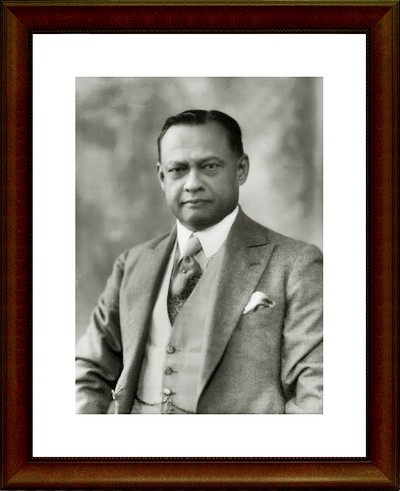
On this day in 1929 newspapers carried an article exposing the sectarian and autocratic character of the Dogra rule. The publication of this article emboldened Kashmiri muslims to raise the banner of protest. Remarkably, the article was written by the serving Prime Minister of Kashmir – Sir Albion Banerji.

Sir Albion R. Banerji, Kt., C.S.I. C.I.E., (1871 – 1950) was the first Bengali Brahman to be born in England, hence his unusual first name. He earned his Master's Degree at the Balliol College, Oxford and joined the Indian Civil Service in 1894. At the Delhi Durbar of 1911, Albion Banerji was awarded the Companion of the Indian Empire (CIE).

He served as Magistrate in the Madras Presidency, and as Diwan of Cochin and then of Mysore before joining the Maharaja's administration in Kashmir as the Foreign and Political Minister.

In 1927 Sir Albion Banerji was appointed Prime Minister of Kashmir.

On March 16, 1929, he published a scathing indictment of the administration of the Kashmir State – criticising the Maharaja's lavish lifestyle sustained by a poor population – and then resigned from his post.

Some excerpts from the note:

'Jammu and Kashmir state is labouring under many disadvantages, with a large Mohammedan population absolutely illiterate, labouring under poverty and very low economic conditions of living in the villages, and practically governed like dumb driven cattle.

There is no touch between the government and the people, no suitable opportunity for representing grievances…

The administration has at present no or little sympathy with people's wants and grievances…'

Sir Albion Banerji's resignation effectively ended his hitherto stellar career in the Indian Civil Service. This act should have made him a hero for the common Kashmiri.

Strangely, or maybe I should say expectedly, there is no mention of Sir Albion Banerji in the sponsored hagiographies that masquerade as history in today's Kashmir. His selfless act has been forgotten because no self-serving separatist, mainstream or 'slipstream' politician can legitimately claim his legacy.

Even the numerous 'civil society' groups peculiar to Kashmir, ever keen to jump on to any 'kashmir/kashmiriyat' bandwagon, have not instituted an award (their favoured ploy to stay news-worthy) in his name – the ultimate ignominy for a man who has had such an undeniable impact on the history of Kashmir.

Perhaps there is an undercurrent to Sir Albion Banerji's service in Kashmir that I have failed to observe, but the fact remains that he championed both the cause of the downtrodden muslim population of Kashmir and of the backward classes of India. Much to the discomfort of his peers, he protested the failure of the Dogra and the British rulers respectively to address their problems.

The erstwhile state of Cochin, which also had cause to honour the gentleman, has a street named after him. I had suggested in an earlier post that the new bridge over the river Jehlum at Rajbagh could be named the Albion Bridge to honour Sir Albion Banerji.

Any takers?