Category Archives: Kashmir

Halcyon Days

Published / by Jehangir

If one were to take to praise Kashmir, whole books would have to be written. . . . Kashmir is a garden of eternal spring, or an iron fort to a palace of kings – a delightful flower-bed, and a heart-expanding hermitage for dervishes.
The Jehangirnama

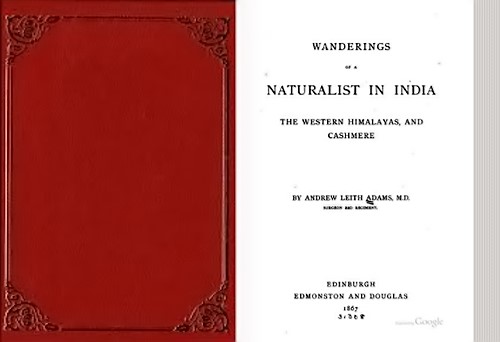
The following passage is an excerpt from:

We could scarcely have chosen a better morning for our excursion. The sun was gilding the snow-covered peaks of the northern Pinjal as we commenced the ascent, and by the time we had gained the temple, his rays, in one flood of golden lights had illuminated half the valley, leaving the southern portion and the slopes of the Peer Pinjal yet intact.

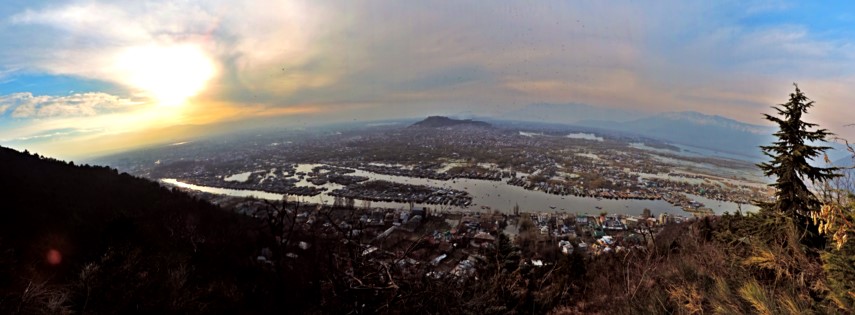
Seldom does he shine on more varied and beautiful scenery, for in all my wanderings before and since I have never witnessed its equal. There lay the capital at our feet, half-hidden among clusters of poplars, chunars, and forest trees – the Dul lake, washing the western base of the Tukt-i-Salaman, stretched westward with all its ever-changing forms.

On the placid waters of the lake numerous skiffs shot either rapidly along, or threaded their way through a labyrinth of weeds, diversified by the countless floating gardens, and the Isle of Chunars, with its noble plane-trees. The Shalimar and pleasure-grounds of the Delhi emperors, now faded, and fast passing into the wild jungle around them, covered portions of the northern bank of the lake.

Huri Purbet, like a fortress which had undergone a siege, its walls crumbling into decay, stood on the side of a spur overlooking a scene which for loveliness and grandeur has scarcely an equal. So perfect seemed both the natural and artificial portions of the panorama so faintly blending with each other, and yet so grand, that the eye in one sweep passed over most perfect pictures of lake and mountain scenery.

Towards the city stretched a noble avenue of poplars, upwards of a mile in length, and straight as arrows ; whilst away towards the east rich pastures and fields teemed with grain ; villages nestled in clusters of trees, which in rows were seen fringing the banks of the classical Hydaspes, that like a huge snake twisted through the plain.

Then, last of the many beauties, rose those grand and noble mountains, encircling the whole panorama, and shielding the paradise from the northern blasts, whilst from their rugged sides dashed a thousand rills to fertilise and beautify its soil.

Operas of the East

Published / by Jehangir

In our childhood days an old family retainer would regale us with his rambling retelling of the adventures of two heroes – Prince Gulfaam and the unnamed hero of Gul-e-Bakawali ( whose name he probably could not recall 😉 )

I. Gul-e-Bakawali

In 1712, Sheikh Izzat Ullah wrote a medieval romance Taj-ul-Mulk Gul-e-Bakawali narrating the tale of Prince Taj-ul-Mulk, Princess Bakawali and a magical flower that could restore sight to the blind. His book was written in Farsi (Persian) prose and over the years a number of authors published their own poetry/prose versions, and plays and later films in various Indian languages were based on the fable.

In 1835, Pandit Daya Shankar Naseem, belonging to a Kashmiri family settled in Lucknow wrote ‘Gulzar-e-Naseem‘ a masnavi (poem with rhyming couplets) based on ‘Gul-e-Bakawali‘. Reputedly verses from the poem became very popular and excerpts from the poem were included in text books.

dekha to woh gul hawa hua hai
kuchh aur hi gul khila hua hai

jis kaf men woh gul ho daagh ho jaaye
jis ghar men ho gul chiraagh ho jaaye

When the poem ran into controversy over its antecedents, Pandit Daya Shankar Naseem was defended spiritedly by Brij Narain Chakbast. Apparently the controversy was fanned at the time by Awadh Punch, an Urdu weekly. Who knew that Punch (1841-1992), the famous satirical British journal, had an Indian clone in the shape of the Awadh Punch (1877-1936), that dared to make fun of British rule during the heydays of the Raj in India!

Pandit Brij Narain Chakbast (1882–1926) himself belonged to a Kashmiri family settled in the erstwhile United Provinces. He wrote some highly-regarded poetry, most famously the following couplet:

zarra zarra hai mere kashmir ka mehmaan nawaaz
raah mein patthar ke tukdon ne diya paani mujhe

[I was reminded of this couplet when our thirsty trekking party encountered cool sweet water flowing out of the rocks on the way to Gangabal from Naranag]

II. Indar Sabha

The story of Prince Gulfaam is even more interesting.

Nawab Wajid Ali Shah, the last Nawab of Oudh (Awadh), was so enamoured by accounts of famous European operas that he commissioned Syed Agha Hassan Amanat to compose an opera in Urdu. The Nawab supervised the production, composed part of the music and performed one of the leading roles in the opera whenever it was performed before courtiers at Kaisar Bagh in Lucknow!

The opera called The Court of Indra or Indar Sabha is a fantasy about the forbidden attraction between Prince Gulfaam (the Flower Prince), son of Gulzar Shah (the King of the Flower-Garden) in Hindustan and the Sabz Pari (the Emerald Fairy) of the heavenly court of Raja Indra, ruler of Paristan (the Land of Fairies) in Koh-e-Qaf (the Caucasus Mountains) beyond Iran.

Gulfaam is a recurring motif in Kashmiri literature, and a mystical couplet describes an idyllic setting thus:

Springtime, fragrant goblets
the evening of the full moon
rhythms of songs of youth
and Gulfaam in front of my eyes

III. Bombur ta Yemberzal

The first opera in Kashmiri was Bombur ta Yemberzal (The Bumblebee and the Narcissus) written by Pandit Dina Nath Nadeem. It is a tale about the doomed love between the Narcissus (Yembarzal) which blooms in springtime and withers away, and the Bumblebee (Bombur) which arrives in summer and searches from flower to flower till it goes blind.

Mohan Lal Aima composed the music for the opera including the famous Bumbro Bumbro song. ‘Bombur ta Yemberzal’ was performed at Tagore Hall in 1955 for Russian dignitaries Nikita Khruschev and Nikolai Bulganin.


Image credit: RIA Novosti

Bombur-Yemberzal as a symbol of selfless love is quite common in popular culture. Mahjoor’s lyrics provide the theme of a Kashmiri-Urdu-Persian fusion song which is a huge hit with Kashmiri youth.

tamanna chaani deedaruk chumo yemberzale bumbro
phaejis yamath laejis wuchney gaejis chaney kaley bumbro

karan mahjoor chu husnas gath vanan yaaras patho akh kath
ye dil deewan gow sei path beyis seith na raley bumbro

Coming back to the old retainer, I don’t know where that illiterate rascal had heard these fantastic tales but his dastangoi – mixing up elements from each other and from other unrelated tales – used to be hilarious yet curiously compelling.

Ah sweet nostalgia!

The History of Healthcare in Kashmir

Published / by Jehangir

The history of modern health care in the pre-independence era in Kashmir is synonymous with the efforts of Christian missionaries. While their motives were admittedly of a missionary nature and their attitude mostly contemptous towards local faiths and customs, yet the pioneering role of the members of the Kashmir Medical Mission cannot be denied.

The first modern hospital in Kashmir was the Mission Hospital at Drugjan. In 2017, I had the privilege to serve as the Medical Superintendent of this hospital, nowadays known as the Government Chest Diseases Hospital. During my research to establish the history of healthcare in Kashmir I came across some rare images which I am sharing here.


Dr William Jackson Elmslie (1832–72)

Dr. William J. Elmslie, the first medical missionary appointed by the Kashmir Medical Mission in 1865 was unable to obtain accommodation due to strong official and public opposition to the missionary component of his medical activities. With typically Scottish derring-do he managed to examine and treat thousands of patients in a single tent which served both as OPD and IPD!

Dr. Elmslie’s successor, Dr. Theodore Maxwell, was politically well-connected and was able to ensure that official opposition was withdrawn. Maharaja Pratap Singh granted the Kashmir Medical Mission land for a hospital at Drugjan on the Rustam Garhi hill.


This image titled ‘Dispensary Tent of the Cashmere Medical Mission’ depicts Dr. Robert Maxwell in Kashmir in 1874. Note the sign at the left of the image.

By means of personal contributions and donations from friends in England, Dr. Edmund Downes erected the first buildings of the Mission Hospital at Drugjan.


Patients recuperating in the upper verandah of the ward named after Dr. Downes.

The Neve Family, notably Dr. Arthur Neve, Dr. Ernest Neve and their sister Ms Nora Neve (Superintendent of Nurses) performed stellar services at the Mission Hospital and in the field. Dr. Arthur Neve was awarded the Kaiser-i-Hind Gold Medal in 1901.


The caption states that ‘These extensive buildings, on a terrace 250 yards long, were erected by the Brothers Neve between 1888 and 1896, at a cost of approximately £15,000, without any Government or other grant’.


Dr Arthur Neve and hospital staff with patients at the Mission Hospital in 1882.


A field health camp being conducted by Dr. Arthur Neve. Note the dispensary table at the right of the image.


It was not uncommon for patients to be transported by boats.

The never-say-die missionary zeal burned as brightly in female medical missionaries as in their male counterparts.

In May 1888, Dr. Fanny Butler, the first female medical missionary in India, started a dispensary in Srinagar city called the “Zenana Shifa Khana” under the aegis of the Church of England Zenana Missionary Society (CEZMS).

Nursing activities were championed by the likes of the indefatigable Irene Petrie who gave up a life of luxury in England to endure hardships in Kashmir, and Elizabeth Mary Newman who was bestowed the title of the ‘Florence Nightingale of Kashmir’ by Tyndale-Biscoe for her work at the CEZMS Hospital. She recieved a Kaisar-e-Hind Silver Medal for her services to the hospital.

The first Church of England Zenana Missionary Society (CEZMS) Hospital was established at Rainawari in 1908. This building was demolished a few years ago to build a shopping complex. (So much for heritage preservation.)


The foundation stone of CE Zenana Missionary Society Hospital at Rainawari was laid by C.E. Tyndale Biscoe on 17th October 1908.

In 1891 the Maharajah of Kashmir donated land and money for setting up a Visitors Cottage Hospital at the foot hills of the Shankaracharya Hill so white people would not have to suffer in the company of natives.

The Visitors Cottage Hospital is nowadays called the Kashmir Nursing Home and I am currently on my second stint as its Medical Superintendent.


Franciscan Missionaries of Mary treating patients at Baramulla in 1921.


Dr. Noel Fletcher examining patients at John Bishop Memorial Hospital at Anantnag in the 1950s.

One positive spin-off of the activities of the medical missionaries was that they prompted the Maharaja of Kashmir to set up the State healthcare services.

The foundation stone of the State Hospital (SMHS) was laid by the Marquess of Linlithgow, the Viceroy of India in 1940 at the estate of the Hadow Mills Carpet Factory. This is the reason why the hospital is known colloquially as Hadwun (Hadow’s) Hospital even today.

The first medical college in Jammu & Kashmir started functioning at Hazuri Bagh on the banks of the Jhelum at the site of the present Lal Ded Hospital in 1959. The Government Medical College Srinagar was inaugurated at its present day location in Karan Nagar by Bakshi Ghulam Mohammed, Prime Minister of the State of Jammu and Kashmir, in 1961.


The first batch of GMC Srinagar.


Students at GMC Srinagar in the 1970’s.

Click this link for a primer on the History of Healthcare in Kashmir [PDF]