Category Archives: Kashmir

Motorsport in Kashmir

Published / by Jehangir

The Jhelum Valley Cart Road from Kohala to Baramulla, then famous as 'the most wonderful mountain road in the world', was completed in 1889 and was extended to Srinagar in 1897. Prior to the advent of the automobile in Kashmir, circa 1915, travellers to Kashmir made the journey in a two-horse four-seater tonga or a single-horse two-seater ekka.
In 1922, public transport was allowed on the Banihal Cart Road, which connected Srinagar with Jammu.

Traffic across the Banihal Cart Road

It was the Maharaja's of Kashmir (surprise, surprise) who owned the first cars in the Valley. During the 1920's Maharaja Hari Singh put together a collection of custom-made Rolls-Royce cars including a 1925 Barker Tourer, 1927 Windovers Limousine and a 1929 Thrupp & Maberly Tourer.

In the late 1920s, the Northern Motor Company, headquartered in Rawalpindi, opened a showroom in the Ganda Singh Building in Lal Chowk. They sold small four-cylinder Chevrolet tourers to local customers for a few thousand rupees.


Chevrolet Tourer on the Jhelum Valley Cart Road

From an endurance point of view the greatest motor adventure was the 1931 Citroën-Haardt Trans-Asiatic Expedition. The achievement of crossing the Himalayas between Srinagar and Gilgit over a pony track across the Burzil Pass (13775 ft) will probably never be surpassed.


Georges-Marie Haardt and his team set out for China from Srinagar on the 12th of July 1931 in specially designed Citroën Kegresse half-tracks. This expedition marked the first motorised crossing of the Greater Himalaya range.


This famous photograph from the Citroën-Haardt Expedition has inspired book covers and movie posters.


Here is a video of the expedition on YouTube. Watch out for 2.15:

More motor stuff next time. Enjoy !

White Swans of Kashmir

Published / by Jehangir

Most westerners that figure in the history of Kashmir were either missionaries like C. E. Tyndale-Biscoe or employees of the Maharaja's like W R Lawrence. However a few like Freda Bedi were involved with Kashmir not as a career option, but because they chose to be.

Freda Bedi was an Englishwoman who met and married B. P. L. (Baba) Bedi at at Oxford University. During the struggle against the Maharaja, the Bedi's were closely associated with the National Conference, especially with Sheikh Mohammed Abdullah.

Their communist leanings are believed by some to be the influence for the admittedly leftist slant of the 1944 'Naya Kashmir' manifesto. Freda Bedi delivering messages to jailed National Conference leaders wearing a 'Burkha' is part of freedom struggle folklore.

My grandmother would sometimes talk about her – especially when Kabir Bedi was on TV. I don't remember the context now but I believe it had something to do with Begum Abdullah, with whom my grandmother had been closely associated. Kabir Bedi, the film actor, is Freda Bedi's younger son. The Bedi family used to own property in my neighbourhood (Shivpora) and I seem to remember that the elder son, Ranga Bedi was a friend of my eldest brother.

Edna Bellafontaine was more of a mystery. Unlike the other two, there is very little information on this Englishwoman, the self-confessed 'Mata Hari of Kashmir'.

Till I came across the news item I thought she was a mid-century painter. I have a painting signed ' Edna Bellafontaine 1949' hanging in my living room, and have seen her works in the homes of certain old families in Kashmir.

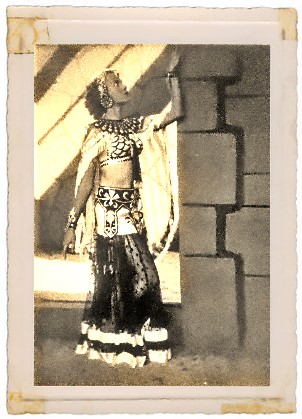
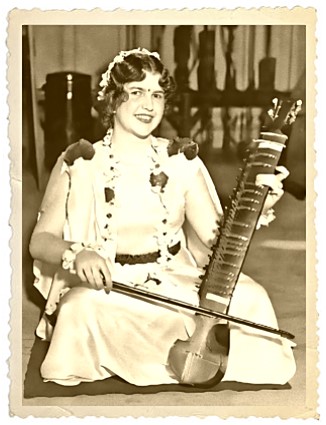
Nilla Cram Cook is the most intriguing of the three. According to a 1933 Time Magazine article titled the 'Runaway Disciple',

'Of all his strange disciples the one who has caused Mahatma Gandhi the sharpest pangs of dismay is plump & pleasing Nilla Cram Cook, 23-year-old daughter of the late George Cram Cook, Iowa poet. …..

……Her difficulty in adjusting her good intentions to her Iowa temperament caused sorrowing St. Gandhi to embark on a hunger strike seven months ago'

Besides being Mahatama Gandhi's most troublesome disciple, she apparently wrote and translated poetry, flirted with mysticism, reinvented dance in Iran, and worked as cultural ambassador for the United States.

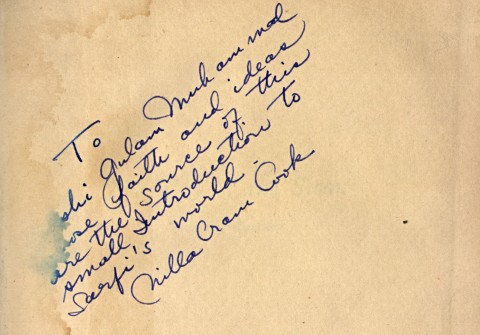
Nilla Cram Cook's Kashmir connection is 'The Way of the Swan', her gem of a translation of the the works of Kashmiri mystics including the Lol's or love poems of Habba Khatoon / Zooni. This is the inscription on a copy of the book she presented to my father: