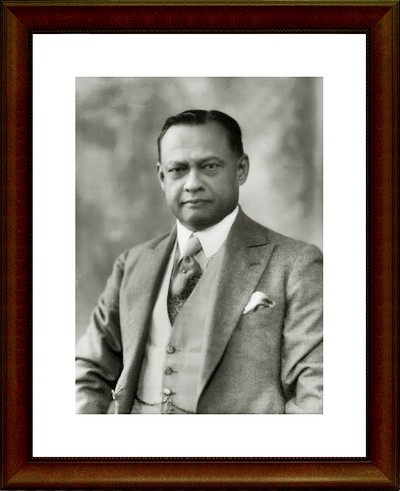
A Bridge named Albion?

Published / by Jehangir

On this day in 1929 newspapers carried an article exposing the sectarian and autocratic character of the Dogra rule. The publication of this article emboldened Kashmiri muslims to raise the banner of protest. Remarkably, the article was written by the serving Prime Minister of KashmirSir Albion Banerji.

Sir Albion R. Banerji, Kt., C.S.I. C.I.E., (1871 – 1950) was the first Bengali Brahman to be born in England, hence his unusual first name. He earned his Master's Degree at the Balliol College, Oxford and joined the Indian Civil Service in 1894. At the Delhi Durbar of 1911, Albion Banerji was awarded the Companion of the Indian Empire (CIE).

He served as Magistrate in the Madras Presidency, and as Diwan of Cochin and then of Mysore before joining the Maharaja's administration in Kashmir as the Foreign and Political Minister.

In 1927 Sir Albion Banerji was appointed Prime Minister of Kashmir.

On March 16, 1929, he published a scathing indictment of the administration of the Kashmir State – criticising the Maharaja's lavish lifestyle sustained by a poor population – and then resigned from his post.

Some excerpts from the note:

'Jammu and Kashmir state is labouring under many disadvantages, with a large Mohammedan population absolutely illiterate, labouring under poverty and very low economic conditions of living in the villages, and practically governed like dumb driven cattle.

There is no touch between the government and the people, no suitable opportunity for representing grievances…

The administration has at present no or little sympathy with people's wants and grievances…'

Sir Albion Banerji's resignation effectively ended his hitherto stellar career in the Indian Civil Service. This act should have made him a hero for the common Kashmiri.

Strangely, or maybe I should say expectedly, there is no mention of Sir Albion Banerji in the sponsored hagiographies that masquerade as history in today's Kashmir. His selfless act has been forgotten because no self-serving separatist, mainstream or 'slipstream' politician can legitimately claim his legacy.

Even the numerous 'civil society' groups peculiar to Kashmir, ever keen to jump on to any 'kashmir/kashmiriyat' bandwagon, have not instituted an award (their favoured ploy to stay news-worthy) in his name – the ultimate ignominy for a man who has had such an undeniable impact on the history of Kashmir.

Perhaps there is an undercurrent to Sir Albion Banerji's service in Kashmir that I have failed to observe, but the fact remains that he championed both the cause of the downtrodden muslim population of Kashmir and of the backward classes of India. Much to the discomfort of his peers, he protested the failure of the Dogra and the British rulers respectively to address their problems.

The erstwhile state of Cochin, which also had cause to honour the gentleman, has a street named after him. I had suggested in an earlier post that the new bridge over the river Jehlum at Rajbagh could be named the Albion Bridge to honour Sir Albion Banerji.

Any takers?

The ‘Flower King’ of Kashmir

Published / by Jehangir

As the snows melt, their whiteness is rivalled by the delicate sprays of early fruit blossoms as seen across the dark background of the cypress trees ; while the pink mist of almond and apricot flowers shows in little patches of colour against the bare hillsides.

Soon the ground under the trees is carpeted with bulbs, scillas, tulips, crown-imperials, narcissus, hyacinth, fritillaries, and iris. Take up a box of old Kashmiri lacquer-work and see how the flowers and colours crowd together.

Lilac, jasmine,and carnations follow ; then, last and best of all, come the roses, giant bushes covered with huge, pink, fragrant flowers, such masses as are seen in Europe only in the pictures of some fairy tale. White roses too, and red and yellow; but the pink roses were always the artist's favourites'.

~ Gardens Of The Great Mughals

Inspired by the impeccable English garden of the hotel run by the O'Connell's in the Batwara suburb of Srinagar in pre-independence days, Ghulam Nabi Wani set up what was probably the first commercial nursery in Kashmir.

In his heyday Ghulam Nabi Florist, as he is popularly called, supplied flowers to Prime Ministers of Kashmir and India and his cutflowers graced the poshest hotels in the country.

Sadly his business could not escape the evil eye that has consumed Kashmir and his efforts are now largely restricted to his nursery in Shivpora. When thousands of his blooms burst forth in the spring, there is no lovelier place in Kashmir.

Kashmir Country Garden

How many kinds of sweet flowers grow

In a Kashmir country garden

I'll tell you now, of some those we know

Those that I miss you'll surely pardon

Daffodils, pansies and phlox

Marigolds and White Snowdrops

Lilacs, Lilies and tall Hollyhocks

Roses, Asters and Tulips

Blue Forget-Me-Not's

In a Kashmir Country Garden…

~ Anonymous

Most of the perennials in my garden have been sourced from his nursery, and though I do not really have the space for more plants, I still visit his nursery each planting season.

This week I scored a bounty of tulips, scented narcissi and irises for my spring garden. This link has some pictures from my garden – past and present.

Have you ever Kippled?

Published / by Jehangir

This post features three of my favourite authors, albeit in a less than laudatory fashion.

Sir Arthur Conan Doyle wrote four novels and 56 stories featuring the fictional detective Sherlock Holmes. They were so wildly popular that a century-and-a-quarter later his creation is the most adapted character in literary history as well as the most played character in cinematic history. Even today Sherlock Holmes receives mail by name at his famous address, 221B Baker Street, as though he were an actual person!

How often have I said to you that when you have eliminated the impossible, whatever remains, however improbable, must be the truth?

An example of Doyle's success in creating a analytical mastermind with unmatched deductive powers is the passage where the fictional Sherlock Holmes deduces Dr. Watson's professional and service background:

Here is a gentleman of a medical type, but with the air of a military man. Clearly an army doctor, then. He has just come from the tropics, for his face is dark, and that is not the natural tint of his skin, for his wrists are fair. He has undergone hardship and sickness, as his haggard face says clearly. His left arm has been injured. He holds it in a stiff and unnatural manner. Where in the tropics could an English army doctor have seen much hardship and got his arm wounded? Clearly Afghanistan.

Pure genius !

Unfortunately the coldly analytical first-and-only 'consulting detective' could not decipher the impossibility of a name like Mahomet Singh in 'The Sign of the Four' (1890).

In 1907, Rudyard Kipling became the first English-language recipient of the Nobel Prize for Literature. The prize citation said: 'In consideration of the power of observation, originality of imagination, virility of ideas and remarkable talent for narration which characterize the creations of this world-famous author.'

Of his childhood in India Kipling wrote that '…one spoke 'English', haltingly translated out of the vernacular idiom that one thought and dreamed in'.

Of his return to India at the age of seventeen years, '…my English years fell away, nor ever, I think, came back in full strength'

Ironically for a man who vaunted his connection with India, his writings were considered paeans to Victorian empire-building in his lifetime, and later discredited as imperialistic propaganda with racial overtones. Case in point :

'The White Man's Burden' (1899)

Take up the White Man's burden-
Send forth the best ye breed-
Go, bind your sons to exile
To serve your captives' need;
To wait, in heavy harness,
On fluttered folk and wild-
Your new-caught sullen peoples,
Half devil and half child.

In 1890, our self-confessed thinker-in-the-vernacular titled a famous poem 'Gunga Din'.

'Tho' I've belted you and flayed you,
By the livin' Gawd that made you,
You’re a better man than I am, Gunga Din
!'

Gunga Din, indeed.

Messrs. Doyle and Kipling may be forgiven for their lapses made over a century ago, but what of our next storyteller?

Jeffrey Archer has topped the bestseller lists around the world, with hundreds of millions of books sold in a hundred countries and some novels nearing a hundred reprints (Kane & Abel). He has also authored plays, collections of short stories, prison diaries, and religious works. He is the only writer ever to have been a number one bestseller in fiction, short story and non-fiction categories.

In a short story titled ‘The Commissioner‘ in ‘Cat O’Nine Tales‘ (2006), one vital character is a Deputy Commissioner of Mumbai Police with the mutually exclusive name of ‘Anil Khan‘. In ‘Politically Correct‘ published in the collection ‘And Thereby Hangs a Tale‘ (2010), we have ‘Professor Naresh Khan, the distinguished American orthopaedic surgeon‘. Maybe they really do things differently in the USA.

Did each one of these grandees feel that even a wee bit of research on ‘sullen peoples‘ was not worth his time or effort?.

Their stand-offishness is the reason why the legacy of the British, unlike that of earlier rulers, was not assimilated into the Indian narrative. Unsurprisingly their rule sired the bastard Hinglish in contrast to the incomparably symbiotic Urdu.

Coming back to the intro, nominal gaffe's notwithstanding, all three are favourite authors, with the best piece of writing being Rudyard Kipling's four stanzas of advice to his son:

If

If you can keep your head when all about you
Are losing theirs and blaming it on you,
If you can trust yourself when all men doubt you,
But make allowance for their doubting too;
If you can wait and not be tired by waiting,
Or being lied about, don't deal in lies,
Or being hated, don't give way to hating,
And yet don't look too good, nor talk too wise:

If you can dream – and not make dreams your master;
If you can think – and not make thoughts your aim;
If you can meet with Triumph and Disaster
And treat those two impostors just the same;
If you can bear to hear the truth you've spoken
Twisted by knaves to make a trap for fools,
Or watch the things you gave your life to, broken,
And stoop and build 'em up with worn-out tools:

If you can make one heap of all your winnings
And risk it on one turn of pitch-and-toss,
And lose, and start again at your beginnings
And never breathe a word about your loss;
If you can force your heart and nerve and sinew
To serve your turn long after they are gone,
And so hold on when there is nothing in you
Except the Will which says to them: 'Hold on!'

If you can talk with crowds and keep your virtue,
Or walk with Kings – nor lose the common touch,
If neither foes nor loving friends can hurt you,
If all men count with you, but none too much;
If you can fill the unforgiving minute
With sixty seconds' worth of distance run,
Yours is the Earth and everything that's in it,
And – which is more – you'll be a Man, my son!

~ Rudyard Kipling

I have kippled, and enjoyed it immensely !

Update: A pivotal character in Star Trek is called Khan Noonien Singh. WTF, Gene!